AK Alder

poet + writer

  • Published Work
  • Blog
  • Resources
  • 🍉
  • Connect
2020-03-14.jpg

On Sickness and Gratitude

March 14, 2020 by Kat Coolahan

Several weeks ago (starting on February 24), I contracted the flu. I woke up that Monday morning coughing and with a general malaise. Soon after, I answered a phone call from my sister (whom I had spent nearly the whole weekend with) who apologized profusely because she had just came back from the doctor’s and tested positive for the flu (type-A).

Having not had the flu since I was a young child, I was skeptical that what I had wasn’t just a cold. However, halfway through that Monday my fever shot up and did not come back down again until Thursday morning. My head hurt so bad during the time I had a high fever that I could not sleep for more than two hours at a time, I could not watch movies or read because focusing my eyes on anything at all was excruciating. I spent three nights in a row awake nearly all night just staring off into space, weak, drained, unable to sleep, barely able to eat. I contemplated the concept of a virus, a lot. I wondered how my body was fairing in the fight.

Once the fever broke, the ride wasn’t over. I spent many more days in bed exhausted with a violent cough. My chronic illness decided to flare just as soon as my fever broke. I quarantined myself in the bedroom and my spouse slept on the couch and fed me all of my meals. For over a week, I pretty much only went back and forth between the bed and the bathroom with no physical contact from another human being and very little socialization or entertainment. The quarantine seemed to work because my spouse never got quite so sick, although did develop a cough and fatigue. Today, 19 days later, is the first day that I woke up and my lungs have felt normal, where my cough has generally subsided.

It has been a wild ride.

I have had a lot of time to think about health, mortality, gratitude, purpose. In the time that I have been sick, MFA rejections have been rolling in, a global pandemic began, and I had to cancel my trip to San Antonio for AWP which I had been looking forward to all year. In the end, though, this experience has really forced me to be thankful in a big way.

I have a ritual at night before I go to bed that I call the “gratitude rock.” I hold a fossilized coral stone I keep on my bedside table in my palm and think of ten things from the day that I am grateful for. With each item I let a finger unfurl until my palm is open to the stone and then curl them back in until I am grasping the stone again. I continued this ritual while I was sick and it illuminated things about my life and experience that I couldn’t have known had I not been so violently ill. I found myself feeling deeply and profoundly grateful for things like my bed, a moment of sunshine, a cuddle from my cat, a text from a friend.

Sometimes my nighttime ritual feels like a chore, a box to tick off. It is tempting to quickly list items like food, shelter, a warm bed, health, etc and not actually feel any gratitude for them. But, nothing in this life is promised. I am not owed any experience or circumstance. Allowing myself to sink into the gratitude of what I do have is a practice that has transformed my life.

I am grateful to be alive.
March 14, 2020 /Kat Coolahan
flu, covid-19, coronavirus, sickness, quarantine, thoughts, gratitude

Boundaries

February 20, 2020 by Kat Coolahan

Boundaries have been on my mind as of late, as both the invisible lines that divide, as well as the demarcations that keep our personal lives safe and sane.

One one hand, boundaries are invisible state lines in the USA that determine who can go to college for what price, who can get an abortion, have access to medical marijuana, and who can use which bathroom. Boundaries enforce laws and regulations. Boundaries are walls erected at borders. Boundaries say you are a Democrat and he is a Republican. Boundaries restrain mixing, keep people and places separate.

And yet, boundaries are also the rules we set for others and how they are allowed to treat us. They are the very foundation of healthy relationships, offering permission to a certain point… and no further. Boundaries are an unwillingness to sacrifice, abandon, or censor the core truth of the self. They are an invitation to collaborate and share, but with stipulations on what goes too far.

Boundaries are complex and contradictory and that makes them worth writing about.

When nature divides itself into boundaries, ecology calls those divisions the edge. Edges are the borders between ecosystems, for example where the shoreline meets the sea or the forest meets the field. Edges are areas where two environments converge. They are important ecological centers of interaction where plants and animals can utilize two environments instead of one, fostering the creation of networks, interdependence, and cohesion.

Using the example of the border of land and sea can illustrate the exchanges that take place. On one side (in the sea) we can find coral reefs teeming with diversity of sea life and on the other side (land) we see tidal pools bursting with life of different forms. Through the edge, there is an exchange of material (salt, rocks, shells, fungus, bacteria, organic matter, etc.) that might not otherwise happen deep at sea or far on land. And those exchanges can and do enhance one another so long as one side does not completely overtake or submit to the other. There is a balance that is upheld in order for both sides of the edge to benefit, if indeed the two are to mix.

The media these days seems to repeat ad nauseam the narrative that the US is “polarized” and that citizens are “more divided than ever.” However, looking to nature, to balance, to healthy social boundaries are there strategic opportunities that lie in wait in the mixing of the boundaries and edges we have created? Then again, can unification and cohesion of “both sides” really be a viable strategy in the threat of fascism? In the face of hatred, of racism, sexism, xenophobia, homophobia what choice is there but for the tides to rise up and obliterate the shoreline?

February 20, 2020 /Kat Coolahan
boundaries, edge, ecology, codependence, us politics, rules, sharing, collaboration, permaculture, questions, pondering
1 Comment

How I Got Distracted During a Digital Detox

December 15, 2019 by Kat Coolahan

It’s Sunday and the first item I wrote on my “to do” list was to write this blog entry. Yet, I cleaned my entire house, cleaned myself (i.e. showered), and made lunch (in the process re-cleaning the kitchen) before sitting down to write. Writing is now one of the last items I will check off having been distracted by cleaning. But, for today, that is okay.

Distractions still find ways to kidnap my focus even in the midst of my own version of a “digital detox” inspired by the book Digital Minimalism. I am of the opinion that digital distractions are among some of the hardest to navigate in present day. Countless sites are engineering our attention and apps are getting more and more addictive. However, distractions go far deeper than the digital world.

Social caretaking responsibilities and administrative tasks will always exist for most people (although in varying and disproportionate rates due to gender, race, and socio-economic class just to name a few). The goal of increasing focus, therefore, cannot simply be attained by eliminating distractions all together. Life is inherently distracting. So instead of avoiding distraction I can instead look to support focus, which I know I can achieve in two ways. By creating both anti-distraction habits and environments that support increased concentration, I support my focus.

For example, when I need to get serious writing and work done, I visit the library. Even with the smart phone in airplane mode, there are always far too many cleaning and administrative tasks at home. I often get stuck in completing those items when I am feeling productive, prioritizing them over my work. The library is an environment that I can count on to support my focus.

Certain sounds are also incredibly distracting for me. So, I have a habit of always carrying earbuds in my bag. I know from experience that thuds, tapping, rattling, and even white noise can send me searching for dopamine hits on websites designed to trap attention. If the library becomes noisy, I can pop them in and listen to music that helps me focus. My favorite right now is this playlist.

Paradoxically, cleaning can sometimes help me focus because cleaning is an environmental change that can support focus. The trick (for me) is to not get mentally exhausted doing the cleaning. I can choose to spend time cleaning worrying about all the work I am not getting done OR I can let the cleaning be more of a meditation, a practice in presence. Exercise and meditation are great for focus, as well. Any activity that helps get the mind into a flow state can quiet negative or fear-based thoughts enough to get into a state of flow.

One thing that I have learned during this digital detox is that, in a world where our attention is increasingly being hijacked to advertisements, it is important to remember that distractions have always and will always exist. And perhaps, because of this fact, it is even more important to stay mindful in all the ways one can support their focus.

December 15, 2019 /Kat Coolahan
focus, distraction, distractions, minimalism, digital minimalism, digital detox, cal newport, distracted, playlist, cleaning, tasks
AT 2019-11-07.jpg

Another Day Hike on the AT

November 07, 2019 by Kat Coolahan

Last weekend I re-visited to the Appalachian Trail in an attempt to hike double-digits on a day hike (a feat I have yet to accomplish and one of my 2019 goals). Unfortunately, I miscalculated the start date of daylight savings and was only able to eke out 9 miles before sunset.

My reward for trying (other than soreness, strength, and the satisfaction of a whole four and half hours in the woods by myself) was getting out of the woods in the magical time of around a half hour after sunset. The autumn leaves lit up in a show as the fiery sky allowed its last traces of light on the day. It was breathtaking.

I chose the book Essentialism by Greg McKeown to listen to on the hour-long drive to the trail. Mindfully choosing audiobooks in order to ponder new thoughts and ideas in the silence of my solo hikes is a ritual I have written about before. However, the day prior, I also got the lucky chance to meet one of the legends of rock climbing, Alex Honnold, who has greatly inspired my thinking and approach to life. Alex made a whirlwind trip from El Capitan to my climbing gym and back again in order to give a talk on the impact of giving, to share some cool new stories, and to sign autographs.

Over those 4.5 hours on the hike, there was a lot of time to think. The gratitude I felt from manifesting the dream I had to meet Alex (and more specifically to shake his hand) was palpable and a feeling I carried with me the entire hike. But, more importantly, his words stuck with me. During the talk, he spoke about the privilege of being born into the comfort and relative safety of a developed country and the moral imperative that drives his own philanthropy. He approaches life with gratitude, not only because he is living his dream, but also because it is what allows him to make the biggest impact.

Essentialism echos these sentiments in its own way. It is a book about mindfully curating a life that fires you up. McKeown emphasizes the importance of creating time to think, something that Alex had plenty of time for on one of his deep water soloing expeditions, which he told us ultimately inspired him to create the Honnold Foundation. McKeown advocates focusing our energy, time, and efforts on the tasks and ideas that allow us to make the highest possible contribution to the world. In a capitalist meritocracy of “more, more, more” where burnout is a badge of honor, he asks us whether busy is the enemy of true productivity. In pursuing fulfillment there is another path. It is to define what is essential and to relentlessly focus on only those things, saying “no” to everything else.

So, my hike became an opportunity to further refine my intentions and to let go… I resolve to continue to use my time to write, to teach, and to protect the natural world and its inhabitants, aiming to always lead with gratitude. I will also remember the necessity of carving out time to think, to ponder, to enjoy nature and the gifts of being alive.

November 07, 2019 /Kat Coolahan
essentialism, greg mckeown, alex honnold, hike, hiking, Appalachian Trail, nonbinary, non-binary, thought, thinking, goals, burn out, burnout, philanthropy, giving, autumn, fall, letting go, gratitude
2 Comments

The Lucky Ones

October 29, 2019 by Kat Coolahan

My mother always made a big deal of birthdays. A festive tablecloth came out on the birthdays of family members, vinyl white with rainbow streamers, balloons, and “Happy Birthdays” painted on. A glass cake tray sat on the table and presents overflowed even when we didn’t have a lot of money. Joy abounded on birthdays. I remember most my mother’s smile while she watched us open gifts. I now have minimalist leanings and often prefer not to receive gifts. But, my love of birthdays and the bliss that accompanies them still grows on that foundation of gifts and excitement originally given to me by my mother.

I find it a challenge to communicate the variety of gratitude my birthday brings without feeling like I’m sounding cliched. But, the thanksgiving is visceral. My body exudes recognition of ALIVENESS while also acknowledging each year, each moment is one closer to the end. It’s overwhelming and invigorating in a way that begs me savor every moment. A quote by the Biologist Richard Dawkins may help to explain:

“We are going to die, and that makes us the lucky ones. Most people are never going to die because they are never going to be born. The potential people who could have been here in my place but who will in fact never see the light of day outnumber the sand grains of Arabia. Certainly those unborn ghosts include greater poets than Keats, scientists greater than Newton. We know this because the set of possible people allowed by our DNA so massively exceeds the set of actual people. In the teeth of these stupefying odds it is you and I, in our ordinariness, that are here.We privileged few, who won the lottery of birth against all odds…”

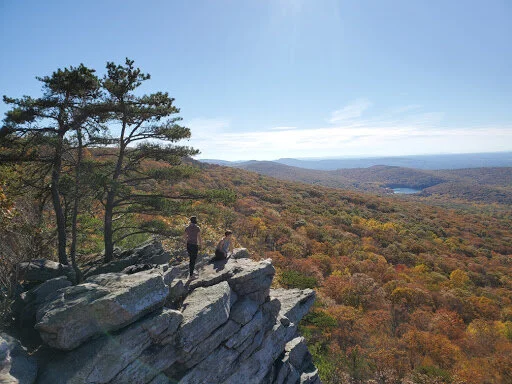
This year I took a day hike with my husband and sister to a section of the Appalachian Trail. We ate a picnic lunch at the summit, bouldered outside for the first time on some menacing rock stacks, and visited a nearby lake (you can see it in the above photo from the summit). They plucked four leaf clovers in the grass bordering the beach and we surveyed the new landscape the light created as the sun dipped behind the trees.

The entire day felt perfect. I felt overjoyed in a way I have not yet felt since moving back to my home state and experiencing the loss of my mother-in-law. The complex battles I have been fighting with anxiety, grief, and depression in the wake of the losses of her friendship/motherhood and the safe home my husband and I created in Oregon have been some of the most challenging of my life. But, as we drove back home with the western sky ablaze behind us, I listened to the words of Rebecca Solnit drift through the car as she spoke of hope in the dark. And, for a moment, I felt such a desire to hold on, to preserve the satisfaction and wildness I gathered from the hike.

Instead… and with great joy… I let it go.

October 29, 2019 /Kat Coolahan
birthday, hike, hiking, at, Appalachian Trail, hikes, family, love, hope, wild, wildness, wilderness, joy
  • Newer
  • Older